In graphic storytelling, senior designer Trilce García Cosavalente turns complex ideas into narratives based on the belief that stories cannot be told in isolation. With over 15 years of experience, her work bridges visual literacy between Nordic and South American cultures. She demonstrates that while AI may be efficient, it lacks the human perspective necessary for genuine social change.
Read the Q&A below to explore Trilce’s insights on cultural aesthetics, the power of graphic storytelling, and the future of human-focused design.
The power of graphic storytelling
How do images compare to words in real-time communication?
Images can work as an effective language in real-time communication because they are easy to process. Compared to images, written or spoken words are often better for explaining in-depth ideas or expressing abstract topics.
Still, images are not completely “universal.” People need a certain level of visual literacy and a shared visual code to understand them properly. This depends heavily on culture and community. In real-time communication, images are most powerful when they work together with words to reinforce the message.
Why is graphic storytelling so effective for social justice and health?
Graphic storytelling combines visual and textual elements in a sequential form that encourages emotional and cognitive engagement. This sequentiality invites the reader to actively process information. Consequently, when information is merged into a connected sequence, it becomes more memorable and emotionally resonant.
Active participation helps readers develop empathy for complex experiences, which is essential when dealing with sensitive topics. Because graphic storytelling narratives are visually relatable, they lower barriers to understanding and make difficult concepts more accessible.
For example, during the pandemic, short graphic storytelling sequences were used alongside charts to explain how the virus spread. These visual stories allowed urgent information to be communicated clearly, reaching audiences beyond those who engage with text alone.
Cultural identity & the “global” comic
How has your Peruvian background shaped your approach to narratives?
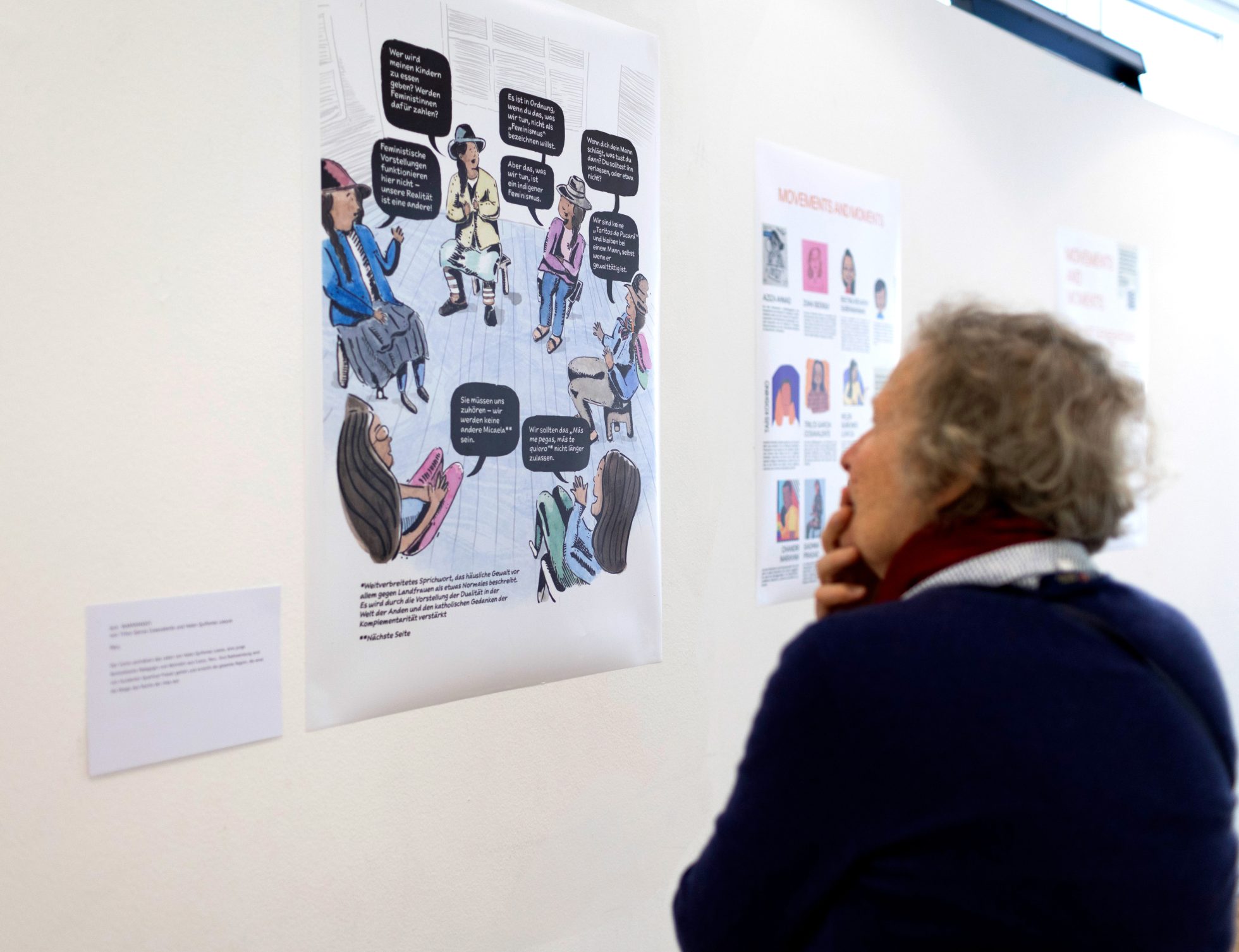
Through years of research and collaboration with Quechua women, I learned that their stories cannot be told in isolation. This has shaped my visual practice to focus on community and shared experience.
From a stylistic perspective, my work is characterised by organic lines and flat colours. Furthermore, there is a political decision in my use of an intentionally “imperfect” drawing style. This challenges the visual authority of dominant design traditions and aligns with an ethic of accompaniment rather than representation.
How do South American and Nordic audiences interpret visuals differently?
Audiences in South America and the Nordic region share a familiarity with comics as a democratic medium. However, the interpretation of visual elements often changes based on local visual literacy.
In Peru, audiences tend to respond strongly to vibrant colour palettes and dense compositions. In contrast, Nordic audiences, especially in Finland, tend to engage more with restrained colour palettes and visual minimalism. Understanding these differences is key to effective graphic storytelling in a global context.
The craft of clarity & emotion
How do you balance emotional engagement with being informative?
I begin every project by asking: What is the core message? What is the most appropriate medium? These questions guide all subsequent visual decisions.
To maintain emotional engagement, I pay close attention to small details that introduce a human presence. For example, I prefer hand-lettering text instead of using digital typefaces. These handmade elements create a spontaneous feeling that helps viewers connect emotionally without overwhelming the information. My goal is for emotional elements to support clarity, ensuring the graphic storytelling remains informative while inviting empathy.
What is often overlooked about graphic narration for social change?
One of the most overlooked aspects of graphic storytelling is the assumption that simply telling a story is enough to generate impact. In reality, how the story is told is just as important as the content. This work requires careful attention to the rhythm, pauses, and the balance between what is shown and what is left to the reader’s imagination.
Value and the future of digital/AI
How do visuals create tangible value for organisations?
Visuals create tangible value by functioning as tools of communication and collective empowerment. Graphic storytelling can amplify community voices, making marginalised experiences visible to wider audiences. For organisations, this results in clearer communication, greater emotional engagement, and increased trust with the communities they work with.
What is the impact of AI on the future of authentic storytelling?
AI has negatively impacted the market because some clients are less willing to pay for human illustration. However, I believe this is a temporary phase. Organisations will eventually realise that human experiences and emotions cannot be authentically replicated by machines.
Creators who craft thoughtful, relatable graphic storytelling will continue to stand out. AI may be efficient, but it lacks the human perspective. Stories are what make us human, and that is something AI cannot match.
Ready to explore Trilce García Cosavalente’s work? Explore her portfolio here, follow her on Instagram, and connect on LinkedIn.