AI visibility is becoming a critical issue for B2B organisations. A recent analysis found that 61.7% of citations in a dataset were “ghost citations”, where content influences an AI-generated answer without the source organisation being mentioned.
For B2B companies, that’s a stark possibility. Your expertise may be informing recommendations, supplier comparisons and buying decisions without prospective customers ever learning where that expertise came from.
The finding comes from the 2026 AI Visibility Index, published by Semrush, one of the world’s largest search marketing and digital intelligence platforms. The company analysed how brands are mentioned and cited across major AI systems, including ChatGPT, Gemini and Google’s AI experiences.
AI visibility is not the same as search visibility
Semrush found that mentions and citations often differ across AI platforms. A company may be recommended by AI systems but seldom cited as the source of information behind those recommendations. Conversely, its content may influence answers without the brand receiving recognition.
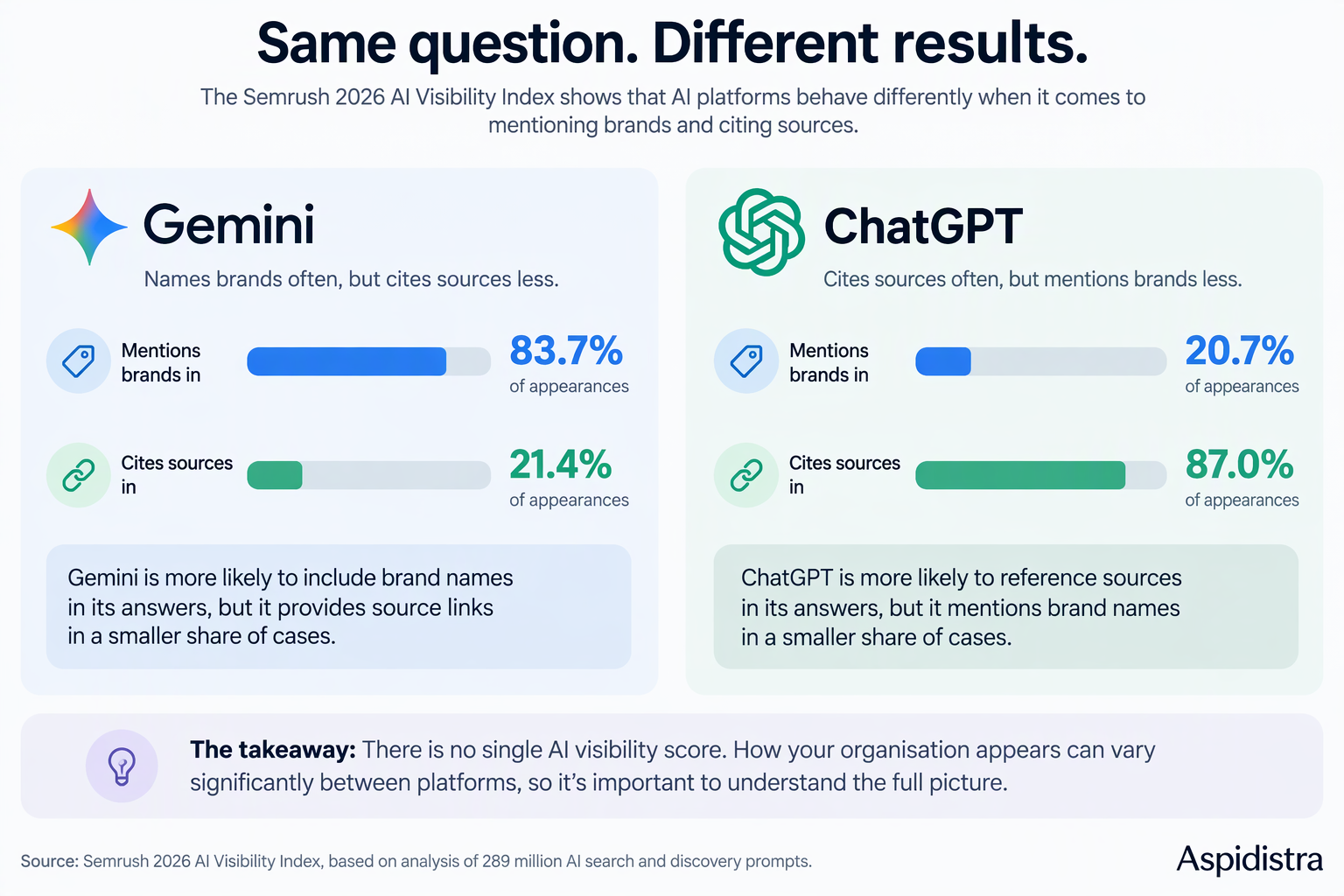
The differences between platforms are also significant. According to the report, Gemini mentions brands in 83.7% of appearances but cites sources in only 21.4%, while ChatGPT cites sources in 87% of appearances but mentions brands in only 20.7%.
For communicators and marketers, this means monitoring a single AI platform is unlikely to provide an accurate picture. An organisation may be highly visible in ChatGPT, largely absent from Gemini, and represented differently again in Google’s AI experiences.
Why this matters for B2B organisations
The commercial relevance becomes clearer when buyer behaviour is considered, with the shift already visible across the Nordic market.
Research from Dansk Industri (DI) (the Confederation of Danish Industry) found that close to a third (30%) of Danish B2B buyers use AI when researching products and suppliers, and almost a quarter (24%) use generative AI tools such as ChatGPT, Gemini and Claude to help identify and compare potential suppliers.
That may still sound like an early-adopter trend. However, another statistic suggests the stakes are higher than many organisations realise. Research by B2B account-based marketing platform 6sense in their 2026 B2B Buyer Experience Report found that 95% of winning B2B suppliers were already on the buyer’s initial shortlist.
Traditionally, that shortlist was shaped by search engines, analyst reports, industry media and professional networks. Today, AI-generated answers are becoming part of that discovery process.
If buyers are asking AI systems which suppliers, partners or experts they should consider, visibility within those answers may influence who makes the shortlist before a sales conversation even begins.
The Nordic market is beginning to respond
Trust also appears to be growing. DI’s research found that 65% of procurement professionals believe AI improves the quality of purchasing decisions. As AI-generated recommendations gain credibility, how organisations are represented in those answers becomes increasingly important.
The shift may still be in its infancy, but there are signs that Nordic organisations are also beginning to treat AI visibility as a measurable business issue rather than a purely technical SEO concern.
In Denmark, AI visibility platform Kime raised €2 million to help organisations understand how brands appear across AI systems. Meanwhile, professional communications organisations including Finland’s ProCom, Sweden’s Sveriges Kommunikatörer and Norway’s Kommunikasjonsforeningen have all increased their focus on AI’s impact on communications, reputation and stakeholder engagement.
This reflects a broader understanding that AI visibility is no longer solely an SEO question. It now sits at the intersection of communications, reputation management, thought leadership and business development.
A new measurement challenge
The lesson from the Semrush report is that organisations should begin by understanding their current position and avoid rushing into AI optimisation programmes. The first step is establishing a baseline.
Questions every B2B organisation should ask:
- How do leading AI platforms describe your company?
- Is the information accurate and up to date?
- Which sources influence those descriptions?
- Which competitors appear alongside you?
- Where are buyers being directed for further information?
- How often does your expertise influence answers without your brand receiving credit?
These questions are becoming important as AI moves deeper into business research and purchasing decisions.
For Nordic organisations, particularly those operating in knowledge-intensive B2B markets, the priority is measuring AI visibility. After all, if AI is helping to shape buyer perceptions, organisations need to know what the machines are saying before they can change the conversation.
FAQ on AI visibility
What is AI visibility?
AI visibility refers to how often and how accurately an organisation appears in AI-generated answers from platforms such as ChatGPT, Gemini, and Google’s AI experiences.
What are ghost citations?
Ghost citations occur when a company’s content influences AI-generated answers but fails to credit or mention the source organisation.
Why does AI visibility matter for B2B companies?
Because AI tools increasingly influence supplier discovery, comparisons, and shortlist creation before buyers engage with sales teams.
How can organisations measure AI visibility?
By monitoring AI-generated mentions, citations, competitor comparisons, source attribution, and referral patterns across major AI platforms.
Key takeaways
- 61.7% of AI citations are ghost citations.
- AI visibility differs from search visibility.
- B2B buyers increasingly use AI tools to evaluate suppliers.
- AI-generated recommendations can shape buyer shortlists.
- Organisations should establish an AI visibility baseline before pursuing optimisation.
Photo by Kyle Larivee on Unsplash